
How to slip stitch in crochet (sl st)
Edited by Bernadett · Updated
To slip stitch in crochet, insert the hook under both loops of the next stitch, yarn over, and pull the yarn through the stitch and the loop on your hook in one motion. One loop stays on the hook and the stitch adds almost no height, which is why patterns use it to join a round, move along a row and sew pieces together. Patterns write it sl st; UK patterns call it slip stitch too and write ss.
- Pattern code
- sl st
- Chart symbol
- a small filled oval
- Loops on the hook
- 1 before, 1 after
- Turning chain
- None needed; many patterns chain 1 before a row of slip stitches and don't count it
What a slip stitch goes into
A slip stitch always goes into something already there: a stitch of the row below, or a chain. To practice, make a chain of 15 and slip stitch along it, or work a few rows of single crochet and slip stitch into their tops.
The top of every stitch is a V of two strands lying along the row: the front loop, nearer you, and the back loop, farther away. A slip stitch goes under both, unless the pattern says front loop only (FLO) or back loop only (BLO).
How to make a slip stitch, step by step
A slip stitch is two motions, so it takes three short steps. They're written for the right hand holding the hook; if you crochet left-handed, swap the hands.
Step 1: Insert the hook from front to back under both loops of the V on top of the next stitch. On a chain, go into the 2nd chain from the hook.
1 loop on the hook
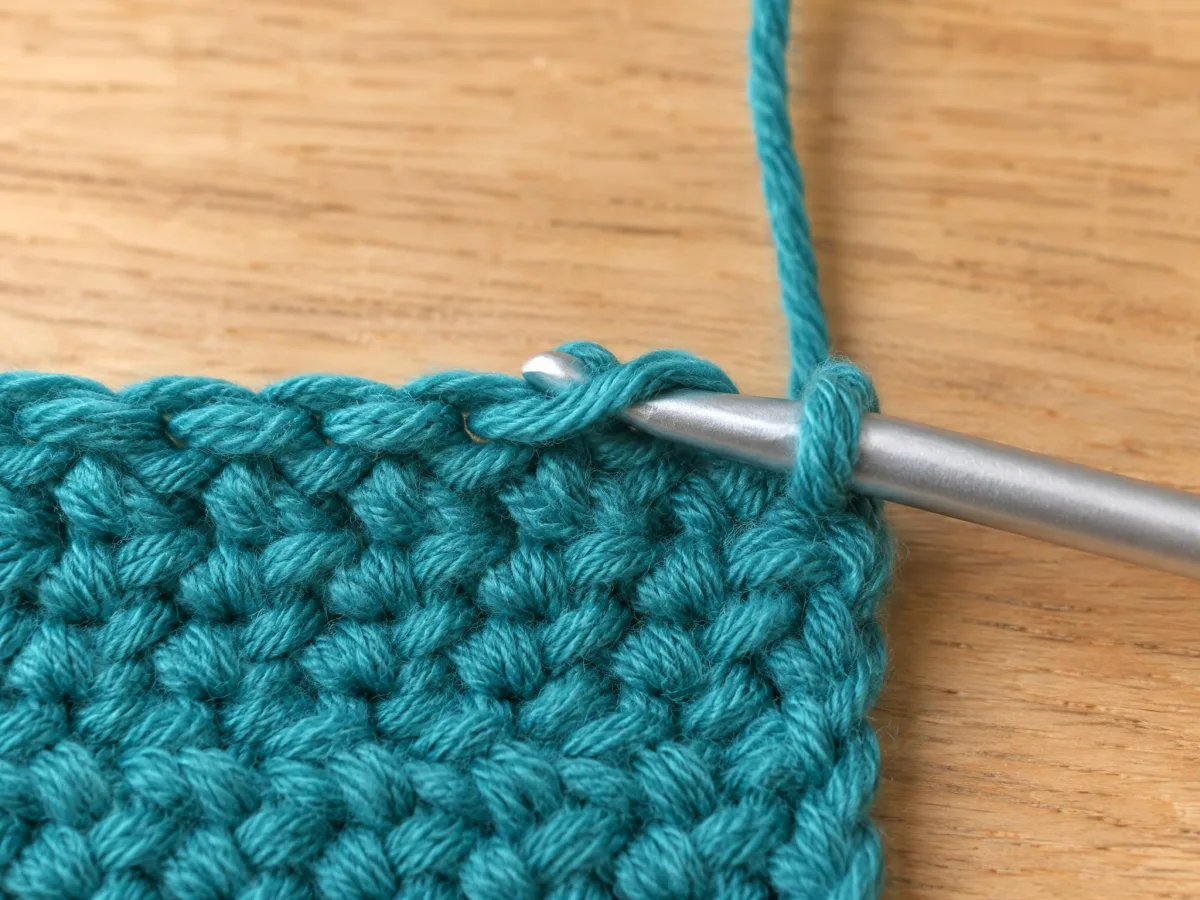
Step 2: Yarn over: bring the yarn over the hook from back to front and catch it in the hook's throat, the notch at its tip.
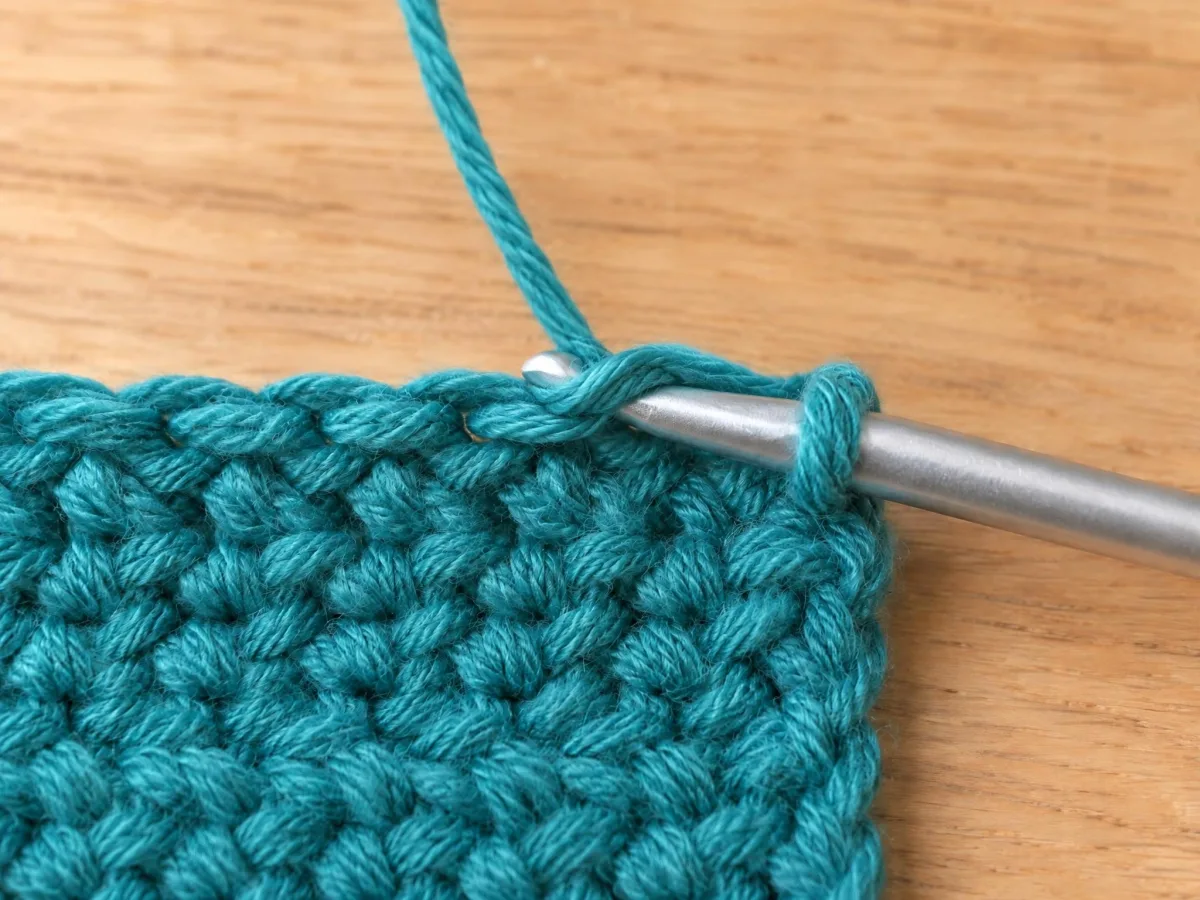
Step 3: Pull the yarn through the stitch and through the loop on the hook in one motion. One loop is left on the hook, and the slip stitch is done.
1 loop on the hook
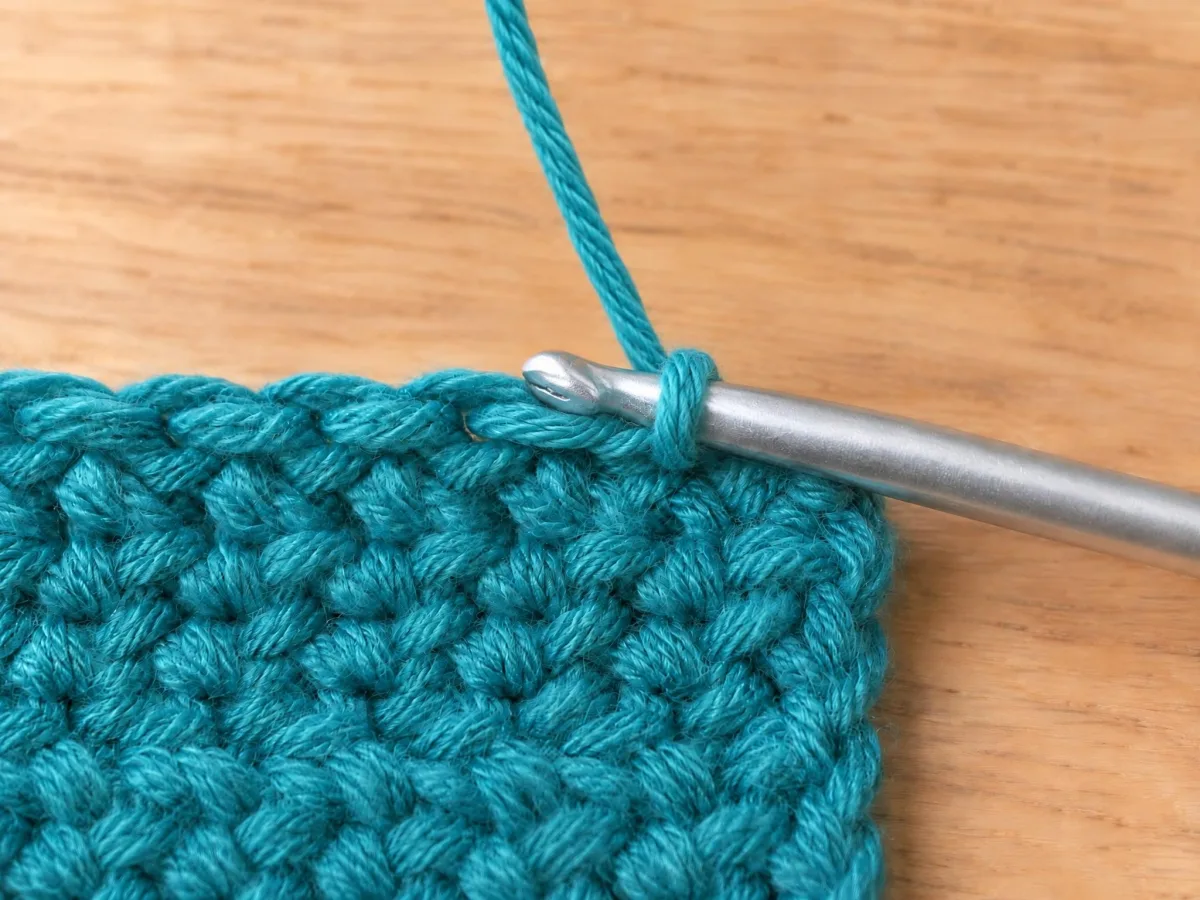
Can you make a slip stitch in two motions?
Yes: pull up a loop through the stitch first, so 2 loops sit on the hook, then pull that new loop through the other one. It's the same stitch with the same single loop at the end.
Working it in two motions helps when your slip stitches come out tight, because you can size the new loop before it closes.
How do you join a round with a slip stitch?
To join a round, work a slip stitch into the top of the first stitch of that round: the hook goes under both loops of the first stitch, then yarn over and pull through the stitch and the loop on the hook. The joining slip stitch closes the round; it isn't a stitch of the round.
A ring of chains closes the same way. "Ch 8, join with sl st to form a ring" means 8 chains, then a slip stitch into the first chain you made.
- Mark the first stitch of every round with a stitch marker, so the join goes into that stitch and not the one beside it.
- Start the next round with its turning chain (chain 1 for single crochet) and never work a stitch into the joining slip stitch: that adds a stitch every round.
- Expect a slight slant. Even joined right, the seam of joined rounds leans a little more with each round, because every stitch leans slightly. Toys worked in single crochet often skip the join and go around in a spiral.
How do you slip stitch across a row without adding height?
Work a slip stitch into each stitch you want to pass: the yarn moves along the top of the row, and the row gets no taller.
Patterns use it to start a row farther in, for example where an armhole begins: they slip stitch across the stitches to leave out, then make the turning chain at the stitch that starts the new row and carry on as usual.
How do you sew crochet pieces together with a slip stitch?
Hold the two pieces with their right sides together, put the hook through the edge stitch of both pieces, and slip stitch along the edge through both layers. The seam ends up inside, where it doesn't show.
Keep the slip stitches of a seam loose: a slip stitch edge is easy to make tighter than the fabric around it.
Where do patterns use the slip stitch?
Patterns use the slip stitch for five jobs: joining a round, closing a ring of chains, moving along a row, seams and slip stitch rib.
| What it does | Where the pattern asks for it |
|---|---|
| Joins a round | "join with sl st" at the end of each round |
| Closes a ring of chains | "Ch 8, join with sl st to form a ring" at the start |
| Moves along a row without height | "sl st across" the stitches to leave out, at the start of a row |
| Sews two pieces together | The finishing steps, as a slip stitch seam |
| Makes a stretchy rib for brims and cuffs | Rows of sl st in BLO, the back loop only |
On a chart, a slip stitch is a small filled oval: the chain's oval, filled in. Slip stitches worked through the front of a finished piece also draw lines on top of it, a decoration called surface slip stitch.
To see a slip stitch in its place among the other codes of a pattern, how to read a crochet pattern decodes a practice pattern row by row, its slip stitches included.
Common slip stitch mistakes
Going under only one loop of the V
Unless the pattern says front loop only or back loop only, the hook goes under both strands of the V. One strand leaves the other one showing as a ridge along the row.
Wrong
Wrong (unless the pattern says front loop only): the hook goes under the front loop alone, leaving the back loop behind it. Right
Right: the hook goes in from the front, under both strands of the V on top of the stitch (the front loop and the back loop). Slip stitches too tight to work into
Pull each new loop up to the full width of the hook, and don't tug the yarn from the stitch you just finished while you make the next one. Making each slip stitch in two motions helps; a smaller hook never does.
Working a stitch into the joining slip stitch
The join isn't a stitch of the round. Skip it and start the next round in the first stitch, or you add a stitch every round.
Taking the turning chain for a slip stitch
On a row of slip stitches, the chain 1 at the start of the row isn't a stitch. Working into it at the end of the next row adds a stitch.